LADIES AND GENTLEMEN, BOYS AND GIRLS... welcome to the big top blog of Douglas McPherson, author of CIRCUS MANIA, the book described by Gerry Cottle as "A passionate and up-to-date look at the circus and its people."

Friday, 10 January 2014

How to organise a book launch and create a media circus

The story of a launch party
in Writers' Forum.


In this article that first appeared in Writer’s Forum, CIRCUS MANIA author Douglas McPherson reveals the behind-the-scenes juggling for the book’s launch party at Circus Space. 


I planned the launch party before I wrote a word of Circus Mania.

In my proposal to Peter Owen Publishers I said, “Just picture the launch party, in a big top, with horses, clowns and acrobats...”

I sent an author photo with myself and an elephant and made up a cover quote: “A jumbo read!” - Sonja the Elephant, who promises to be at the launch.

That may sound forward, but I believe enthusiasm is contagious. Circus is a colourful, larger-than-life world. I wanted to get that spirit across to the publishers, reviewers, retailers and book-buyers - and I wanted a launch that would set the tone.

Circus Space
- the circus school where
Circus Mania
was launched
Circus Space
Although we discussed launching in a big top, we eventually opted for Circus Space, the UK’s foremost circus school (and now the National Centre for Circus Arts), which is located in a former power station in the trendy, media-friendly London borough of Hoxton.

One reason was accessibility. A big top show would have meant a trip out of town and as Michael O’Connell, the marketing manager, pointed out: “It’s hard enough getting literary editors to a bar in soho.”

Just as pertinently, Circus Space’s publicity man, John Dix, was excited by Circus Mania (which has a chapter on the school). He suggested we hold the launch as part of their open day on World Circus Day and promised to publicise it to Circus Space’s huge database of past students and circus folk.

This created possibilities for advance publicity. Theatrical newspaper The Stage ran a special circus issue and included a half-page article on the launch. I was also able to write an opinion piece on whether circuses should have animals for the Daily Telegraph’s website. They ran it on the day of the launch, giving Circus Mania! a huge plug.

Star attraction
How The Stage
reported the Circus Mania launch
with Gerry Cottle (L)
author Douglas McPherson (C)
and Dr Haze from the
Circus of Horrors
I wanted a celebrity on hand for photo opportunities and because getting the book signed by a circus star would be an added draw to circus fans.

Here I must pay tribute to the best known circus man of the past 30 years, Gerry Cottle. Knowing Cottle would be the most meaningful name to provide a cover quote, I emailed him some chapters and he sent a fantastic quote the next day: “Circus Mania is a passionate, up-to-date look at the circus and its people.”

Having already helped me so much, I didn’t expect him to travel to London from his Somerset home, but within five minutes of inviting him to the launch, he phoned and said, “I’ll be there and give you all the help I can.”

At that point it didn’t matter if any other circus ‘names’ turned up. We could tell the press and fans we had the big one.

Roll up, roll up!
While Michael concentrated on inviting literary editors and critics, I emailed an invitation to everyone in my address book. Some were editors and journalists I hoped would give the launch advance publicity, even if they didn’t attend. And I got a plug in some surprising places, such as a quarter page in car magazine Classic American, which has nothing to do with circuses or books, proving that editors tend to support their writers.

I also invited contacts in PR firms, people I’d interviewed, general acquaintances and people I barely knew. After all, who knows if some of them might be circus fans, or spread the word to a friend who was?

Proving the ‘you never know’ theory was a PR whose most recent communication had been to berate me for writing “the nastiest article I’ve ever read” about her client. Not only did she promise to come but she added, “You probably didn’t know I used to be a clown...” I wondered if she was going to bring a custard pie.

Inside Circus Space
It was heart-warming to get good luck messages from people I wouldn’t have expected to care less about my book - and to reconnect with old friends, such as Roger Foss, my former editor at What’s On.

“I’ll be the one in the sparkly tights!” Roger emailed.

“As long as they don’t clash with mine!” I replied.

What I didn’t realise was that Roger had a guest spot on LBC Talk Radio. A few days later I got an email from a friend: “I’ve just heard them talking about your book on the breakfast show...”

Timing
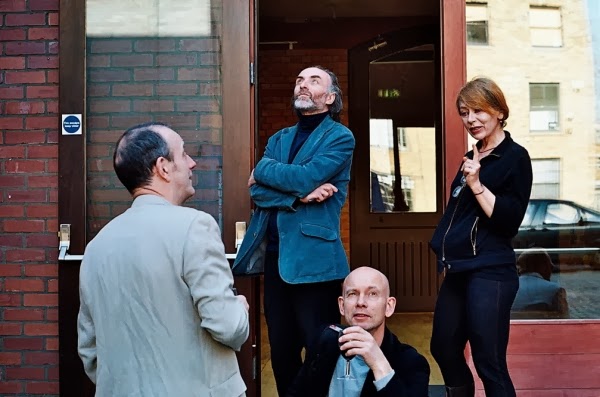
Hoxton hipsters chilling on the terrace
(including marketing man Michael O'Connell, centre)
at the Circus Mania launch party.
The launch party pictures were taken by
Anita Makri
www.photography.anitamakri.com
We announced the launch on the day I received the page proofs. They came with a schedule arranged with military precision: Proofreader’s Qs to author 25 Feb; Queries answered by 1 Mar; Second proof for indexing 10 Mar; Index by 17th; Final Qs by 23rd; To print 25th; Delivery 9 April - a week before the launch, so not much margin for error.

“It’s always a nail-biting race to the finish,” said overseas rights manager Simon Smith. Michael said he’d attended launches  where they didn’t have the book ready. He assured me we’d be OK, but his words came back to me as I waited for the proofreader’s queries and realised we were already a week behind.

Showtime!
Two days before the launch, with no sign of the book, I asked Michael if it was back from the printers. “I know we’re cutting it fine,” he replied, but assured me the printer would deliver copies direct to Circus Space in time.

Gerry Cottle to Dr Haze: "It's not a
rock'n'roll show!"
And so on the big day  found myself driving from Norwich to London with no idea if the books would be waiting for me. What a relief, then, to walk inside and see piles of freshly minted Circus Mania paperbacks laid out like a feast on a crisp white tablecloth.

Having spent a year writing, researching and publicising the book it was wonderful and quite moving to finally hold one in my hand. Flipping through the pages, I felt another wave of relief, as editorial director Antonia Owen had told me she’d known launches where the printer had put the wrong book in the cover.

Our hosts at Circus Space did us proud, with uniformed waitresses serving drinks against a backdrop of people swinging on the trapeze and walking the tight-wire. On the sunny terrace outside, students strolled about, juggling with balls and clubs.

I didn’t perform myself - the relaxed mood was more suited to mingling than a formal reading. But Gerry Cottle made a nice speech and said he thought Circus Mania would give a good boost to the circus industry. Dr Haze, the charismatic ringmaster from the Circus of Horrors, graciously signed books for the fans, as well as posing for publicity pictures with me.

Publisher Peter Owen
who was this year
awarded the OBE for
services to literature
With plenty of people from Peter Owen manning the book stall, I was free to meet and greet, shake hands and sign books. The three hours passed in what felt like a third of that time, and as the tables were cleared away I felt it had been a huge success.

I particularly enjoyed the opportunity to meet and thank all the people from Peter Owen - and to discuss future strategy with them, such as which were the most circus-orientated countries to target for foreign rights.

The most rewarding part of the day was, of course, seeing the readers who’d come along to buy a copy. I’ll never forget the beaming face of the young American lady who bought the very first book. She looked so excited I thought she was going to faint. She made me feel like the biggest star in the world as I inscribed her copy with the traditional big top salutation: May all your days be circus days!

Circus Mania
- Loved by clowns!
Click here to buy your copy of Circus Mania in paperback or ebook format from Amazon - and may all your days be circus days!

And click here to see a history of Circus Space in pictures!

20 Years on: How Eva Garcia inspired behind-the-scenes circus book

Bravery, brilliance and beauty
inside the Big Top
- Circus Mania

in the Norwich Evening News


The bravery, brilliance and beauty inside the big top was the headline of this feature by Derek James in the Norwich Evening News, in which author Douglas McPherson reveals the inspiration behind Circus Mania.

Today most of the animals have gone but the circus has survived and delights a new generation of fans with humans taking centre stage as exotic acts from around the world fly around the big top.

The Great Yarmouth Hippodrome
- Britain's oldest circus building
where the story of Circus Mania began
Our very own circus master and showman Peter Jay has proved beyond all doubt that the circus can survive without elephants, tigers and lions, as thousands of people of all ages and all walks of life queue up to enjoy his colourful shows at the Hippodrome in Great Yarmouth.

The story of the circus and how it has managed to keep going and adapt over the centuries is a fascinating one which has now been taken up by Norfolk writer Douglas McPherson.

His new book, Circus Mania, is a behind-the-scenes journey through the world of circus from Norfolk’s very own piece of circus history, the Hippodrome, to the world famous Cirque du Soleil.

Along the way Douglas talks to clowns, sword-swallowers, trapeze artists and tiger trainers about their lives, culture and history.

“Circus folk are a breed apart,” says Douglas. “I wanted to tell their story, because it’s seldom been told before.”

The inspiration for the book came when the theatrical newspaper The Stage asked him to review the Hippodrome show back in 2003.

Inside the Great Yarmouth Hippodrome
- where the ring becomes a pool!
(a picture from Circus Mania)
“This was the first time I had been to the circus for decades and I didn’t know what to expect. I certainly didn’t expect the steamy humidity of a jungle, the pungency of chlorine... and synchronised swimmers,” he said.

“What Jay delivers instead of horses and lions is spectacle. He dresses the circus up with an exciting blend of ear-splitting chart music, nightclub lighting and MTV-style dance routines, fountains and swimmers.

“But behind all the razzle-dazzle are human circus skills that rely on one thing alone: the almost unbelievable skill, strength and bravery of the men and women who perform them,” says Douglas.

He talks about the Valez Brothers who took his breath away on the Wheel of Death and then he meets Eva - Eva Garcia.

Eva Garcia
"You really have to love it
to live in the circus."
“Hers is a graceful act, equal parts artistic and gymnastic, a gravity-defying ballet performed in the air high above our heads in the roof of the Hippodrome.

“She is a stunningly attractive woman, who’s green eyes and exotic features are evidence of her mixture of Spanish, English and Irish blood - and, perhaps more than anything, circus blood,” writes Douglas.

Eva tells him: “There are a lot of good things about the circus. But then there are a lot of bad things.

“It’s very tough, mentally and physically. You really have to love it to live in the circus.”

Eva told Douglas she had worked out she had another ten years of performing ahead of her. And she adds, with a laugh: “You still have to have good tricks, but these days you don’t have to kill yourself.”

Douglas said it was a good quote which came out in his story in The Stage the following week.

“Whether Eva gets to read, however, I don’t know. The day after the interview, Eva falls 30 feet during her act. She dies instantly,” he writes. “The word bravery is bandied about lightly in the arts. Often it refers to nothing more daring than an unusual choice of song.

“For the circus breed it is a nightly way of life and, sometimes, death.”

The show must go on forever
How the Mail on Sunday
reviewed Circus Mania
Circus Mania - The Ultimate Book For Anyone Who Dreamed of Running Away With The Circus was described by the Mail on Sunday as “A brilliant account of a vanishing art form.”

Click here to read four 4-star reader’s reviews and buy the paperback or ebook from Amazon.


Thursday, 9 January 2014

5000 sign petition opposing ban on circus animals

Should circus animals be banned?

News coverage of protests against circuses with animals frequently refer to a UK Government poll that showed 98% of people support a ban on animals in the circus. But how many people were actually asked and who were they?

The survey was apparently carried out during the year I was writing Circus Mania - a period in which I was visiting a lot of circuses and speaking to a lot of circus people - yet I didn’t hear about it. So the pollsters obviously weren’t standing outside circus tents soliciting the opinion of the circus-going public.

Would the results be different if they were?

Showman Silvio Zammit of Circo Orfei did just that, and has gathered 5000 signatures on a petition opposing a ban on circus animals in Malta.

Zammit argues that only 390 people took part in a Maltese government consultation, of which 49% said they were against animals in circuses.

Zammit admits he lacks the manpower to conduct a national survey and can only solicit signatures for his petition in towns where his circus is appearing.
But wouldn’t it be interesting if other circuses around the world did the same and pooled their petitions over a six month period?

Circus animals - a skeptic's story


I was brought up to believe that the idea of performing animals in the circus was wrong. It was the daredevilry of human performers in all-human shows that drew me into the world of the circus. But when I began writing Circus Mania I knew I would have to attend an animal circus to see a glimpse of circus tradition, because that was where the history lay. 

It was with very mixed feelings that I attended the Great British Circus, Britain's last to feature tigers and elephants. But I watched the show, and others like it, inspected the animals backstage and interviewed animal trainers, current and retired, about their work. 

I have written about my findings as an open-minded skeptic in The Guardian, the Daily Telegraph and The Stage. Read the results of my personal investigation into the world of circus animals in Circus Mania - The Ultimate Book For Anyone Who Dreamed of Running Away With The Circus. 

Click here to buy Circus Mania from Amazon. 


4-star review
How the Mail on Sunday
reviewed Circus Mania
"Circus Mania is a brilliant account of a vanishing art form."
- Mail on Sunday

"The greatest show on earth... in a book!"
- World's Fair


Click here for my pictures of Thomas Chipperfield and the only big cats left in a British big top.

Wednesday, 8 January 2014

Circus Mania "captivating and strangely beguiling" says Eastern Daily Press


Circus Mania author Douglas McPherson
interviewed in the
Eastern Daily Press


Roll up, roll up, for a glimpse behind the greasepaint.


In this double-page feature from the Eastern Daily Press, Steve Snelling interviews Douglas McPherson about Circus Mania.


Roll up, roll up, for a glimpse behind
the greasepaint
- Circus Mania featured in the Eastern Daily Press

There was something extraordinary about Eva Garcia that would live in the memory. Exotic and quixotic in the way of so many great circus performers, she seemed the very personification of beauty and bravery as she held the audience at Yarmouth’s Hippodrome spellbound with her grace and gravity-defying aerial ballet.

Eva Garcia
- her life and death in the
sawdust circle was
the inspiration for
Circus Mania
Climbing two bands of silk, she threw figures and struck poses, “letting go with her hands and trusting her weight to the silk” as she rearranged it in loops around her waist, a knee or ankle.

Among those lost in her thrall that day was journalist and writer Douglas McPherson who could scarcely remember his last trip to the circus let alone recall revelling in so many visceral close encounters with performers whose gymnastic displays teetered magnificently “half a heartbeat from disaster” as they somehow contrived to make the “impossible possible.”

To a man more used to reviewing pantomimes, plays and seaside variety shows, the experience was quite literally breathtaking and awe-inspiring.

“I was amazed,” he says. “We’re so used to seeing all this computer trickery in films, but there’s none of that in the circus. It’s right there, for real, and these guys are doing things that just look impossible, and they’re doing it twice a day, making it look easy.”

Still marvelling at Eva’s act, he sought her out afterwards for an interview.

“Because this was my first real interest in the circus, I wanted to find out what made these performers want to do this,” he remembers. She spoke to him candidly about the harsh realities of circus life, the hazards, the injuries and the loneliness, but he also saw in her a rare passion for something that was not so much an entertainment as a way of life.

“The circus was in her blood,” he says. “She was part of a 100-year-old circus family and had travelled all around the world. I was fascinated by the whole lifestyle.”

At 38, the former wire-walker thought she had 10 years of performing ahead of her and, having talked about the changing face of the circus with its far greater emphasis on presentation, she closed with the comment: “You still have to have good tricks, but you don’t have to kill yourself.”

Eva Garcia
in the costume she wore
for her final
performance
A week later, on the day after his article was published, Eva Garcia fell 30 feet to her death in the middle of her act.

“It was a real shock,” he says, “but it brought home to me in the most powerful way imaginable just how much of a matter of life and death the circus can be. It can happen at any moment. It’s a bit like being a pilot. It all looks safe, all those planes floating around in the sky, but one mistake and you have a terrible disaster on your hands. It’s about being on that knife-edge. And the fascinating thing is these people are addicted to it. They love it.”

Something of that fascination infected him, too. From that moment at the Hippodrome, the writer was hooked on the circus. All preconceptions about an entertainment that had long slipped from his radar were swept away by that intoxicating mix of seemingly reckless skill and grand spectacle.

At every opportunity he found himself seeking fresh circus experiences crammed with a dazzling array of weird and wonderful acts. Though he didn’t know it then, he was embarking on a circus odyssey of his own. It was a heady journey into largely uncharted territory in search of the magical spirit of the circus which has culminated in a real page-turner of a book that shines a bright light on a hidden world inhabited by an extraordinary cast of colourful characters.

In McPherson’s captivating Circus Mania, which he has dedicated to Eva Garcia, the Spanish performer who helped fire his imagination, we are treated  to the literary equivalent of a fly-on-the-wall documentary as we go behind the scenes and beneath the surface of circus life to encounter the likes of the Valez Brothers, and their death-flirting routine on two man-size hamster wheels, sword-swallowing Hannibal Helmurto, the Pain Proof Man who proves that he knows rather more about pain than he likes to let on, and a teenage clown called Bippo who is never more serious than when it comes to making people laugh.

Bippo
- the boy who ran away with
the circus. His story is just
one of many in
Circus Mania
“Bippo’s was an amazing story,” says McPherson. “Often when you meet these guys you can’t imagine them doing anything else, and he was a case in point. I was talking to him backstage. He had all his clown gear on and he was totally unselfconscious about it all. It was as if he never wore normal clothes. You think, this guy was born for this life.”

In fact, Bippo, who’s real name is Gareth Ellis, is one of those who is actually living out the ultimate in childhood dreams. For he actually ran away with the circus. What’s more, his parents ran away with him. His dad became a general handyman, his mum took over as the boss’ personal assistant and he started off selling merchandise before progressing to clowning and juggling.

Though he confesses to never having had such an urge himself as a child, McPherson reckons that after years of hanging around circuses and circus people he can see the attraction. “There’s something very different about that world,” he says. “There’s a sense of community and a realisation that it’s a lifestyle, not a job. In other aspects of show business, people still go home and have normal lives in normal houses like anyone else, but when you sign up for the circus you walk away from real life completely.

“You’re living in caravans, travelling all over the place and you have a completely different set of rules. And I think that appeals to a lot of people.”

That said, many performers, like Eva Garcia, are born into the circus. They know nothing else and, no matter what the risks or hardships, they can never imagine doing anything else.

“Various families have been involved for anything up to 200 years,” says McPherson. “It’s been passed down through the generations. Young kids work their way into it and they seldom leave, they seldom turn their backs on it, and most of them certainly aren’t in it for the money.

The Great Yarmouth Hippodrome
- Britain's oldest circus building
where Circus Mania author Douglas McPherson's
journey into the world of
the circus began
“Of course, you see some shows which are phenomenally popular. Companies like the Chinese State Circus and Cirque du Soleil and places like the Yarmouth Hippodrome draw huge crowds. But you can also go and see some of the traditional tent shows and find yourself sitting among half a dozen other people. And it might be the depths of winter, snow piled up outside, when hardly anyone is going to turn up to sit in a freezing cold tent, but these performers are still up there, doing their trapeze acts, risking life and limb. You ask them why and they reply, ‘What else would we do? This is our way of life.’”

During his exploration of the circus in all it’s myriad forms, McPherson has experienced a range of styles both on the grand and the small scale, from the glitzy glamour of the lavish multi-million pound Cirque du Soleil to the raw sawdust magic of the Circus Mondao big top, and from the avant garde artiness of the Spiegeltent in Norwich’s Chapelfield Gardens to the rock’n’roll razzmatazz of Peter Jay’s enduring and endearing family-run, animal-free, water-splashed extravaganzas at Yarmouth’s Hippodrome.

Circus Mania author Douglas McPherson
with Gerry Cottle (left) and Dr Haze from the
Circus of Horrors
He has rubbed shoulders with entrepreneurs such as Gerry Cottle, a worthy successor to the likes of Barnum and Smart, and he has winced at the gurning feats of Captain Dan, the Demon Dwarf, and a ghoulish host of fiendishly clever performers from the macabre, freak show-inspired Circus of Horrors.

All of them find a place and a voice in McPherson’s strangely beguiling examination of a form of entertainment like no other.

And though he never shies away from the continuing concerns over the alleged abuses of animals in circuses, something he saw no evidence of throughout his journalistic survey, his main interest is in the human performers and their ever more daring quest for thrill-seeking stunts.

“These people push themselves to the limit doing really unusual and phenomenal things that you simply don’t see in any other sphere of show business,” he says. “You have all the atmosphere, that other worldliness, and then there’s that pure spectacle. There’s not a show I’ve been to when one of the performers hasn’t done at least one thing I’ve never seen before, something that makes you think, ‘that’s absolutely amazing. How did they do that? Why did they do that to themselves?’”

Circus of Horrors
sword-swallower Hannibal Helmurto
- one of the amazing characters
who's story is told in Circus Mania
Having said all that, he readily acknowledges that there are many people who have a negative perception of circuses. “People see it as being quite old fashioned,” he admits. “Peter Jay will say the same. He hardly uses the word circus  because he wants to present circus-style stunts within a variety show format, and to a certain extent that’s the way circus is going and where a lot of the future lies.”

For now, though, he reckons diversity is what circus is all about, with different strands of circus offering different things to different audiences while sharing a common heritage.

My feeling in reading his book, however, is that for all his admiration at the polished theatricality and potentially lucrative appeal of the shows staged by the likes of Cirque du Soleil and Cirque de Glace, McPherson is more at home in a traditional big top.

He certainly doesn’t disabuse me.

"When you go to the big top, 
it's the real thing. It's like stepping
into the past"
- Circus Mania author
Douglas McPherson
“When you go to see the big tent style tradition show there is a sense that this is the real thing,” he says. “It’s like stepping into the past. You turn up on a windswept common where they’ve got the tent surrounded by lorries and you can’t help thinking, broadly this is as it was hundreds of years ago.

“It’s not television. It’s not film. It’s not theatre. You’re sitting around the ring, maybe on muddy ground, on a plastic patio chair, and all these thrills and stunts are right there in your face. There’s a definite romance to that, an appeal that goes well beyond the safe experience of sitting in a theatre and seeing things performed on a stage. And I think because of the appeal of that, those shows will always survive.”

Furthermore, he hopes that by giving people a glimpse inside what he describes as a “totally unique world,” he can assist in ensuring the appeal of circus in all its guises lives on.

Funny men
- Clive Webb and Danny Adams
“I’d like to think my book might make people just go and re-discover the circus the way I did,” he says. “It’s so easy to forget it’s there. So easy to think it’s just something to take the kids to in the summer holidays, when really it’s something for all age groups and something that will get them fired up about.”

Before closing our interview, I can’t resist asking him what his favourite act was of the many he has gasped or simply gawped at over the past eight years. It proves a tough call and after a slight pause he plumps for a couple of clowns he saw perform at the Yarmouth Hippodrome and who sometimes perform their own show, Circus Hilarious.

“Clive Webb, who was once the phantom flan-flinger in Tiswas, and Danny Adams are such funny people, funnier than anything you’ll see on TV.” he says. “Some people have a good script, but these guys have funniness inside them. The warmth comes out and you can tell they’re really enjoying themselves.

“They’ve got that passion for it which really characterises so many circus people.”

Circus Mania by Douglas McPherson is published by Peter Owen.
Click here to buy Circus Mania from Amazon.

Circus Mania in the news

"Roll up, roll up, for a glimpse
behind the greasepaint."
- Some press coverage of Circus Mania


My thanks to all the journalists who have reviewed or featured Circus Mania so far. Click here to read a dozen reviews of what the Mail on Sunday called "A brilliant account of a vanishing art form."

Tuesday, 7 January 2014

15 Circus Facts - A Bluffer's Guide for World Circus Day, 16 April 2022

Circus Mania author
Douglas McPherson
(sorry, just clowning!)


Ladies and Gentlemen, Boys and Girls, Saturday 16 April, 2022 is the 12th World Circus Day. Roll up, Roll up for the Circus Mania bluffer's guide to circus history and culture with these 15 fabulous facts about the sawdust circle.

Billy Smart's Circus
in the days (1954)
when polar bears and black bears
were a common sight
in the sawdust circle

1 - The word Circus dates from Roman times when arenas such as the Circus Maximus staged chariot races, gladiatorial contests and mock battles.

2 - The modern circus was founded in London by trick horse-rider Philip Astley, who opened his Amphitheatre of Equestrian Arts in London, in 1768.

3 - Astley’s rival Charles Hughes was the first to use the word circus in the modern sense when he founded the Royal Circus.

4 - A standard circus ring is 42-feet in diameter.

5 - Clowns are nicknamed Joeys after 19th century pantomime star Joseph Grimaldi.

6 - Leotards are named after the first star of the flying trapeze, Jules Leotard.

The 5 Talos
were the stars of Bertram Mills Circus
at Olympia in 1952
7 - The word jumbo, meaning large, entered the English language because of Jumbo, an 11-foot-tall elephant that the American showman PT Barnum bought from London Zoo.

8 - The traditional circus theme music is called Entrance of the Gladiators.

9 - Charlie Cairoli was the first clown to appear on This Is Your Life.

10 - Chinese acrobats first appeared in European circuses in 1866.

11 - Cirque du Soleil was created as part of 1984’s celebrations to mark the 450th anniversary of Jacques Cartier’s discovery of Canada.

12 - Circus Space, in London, is the UK’s only training facility to offer a BA (hons) degree in circus arts.

13 - The first American circus was founded by John Bill Ricketts in Philadelphia.

14 - A ‘Josser’ is an outsider who joins the circus.

15 - According to circus superstition, it’s bad luck to wear green in the ring.

For more on the history of circus, and the lives of today’s performers, read Circus Mania - The Ultimate Book For Anyone Who Dreamed of Running Away With the Circus by Douglas McPherson.

“Circus Mania is a brilliant account of a vanishing art form.”
- Mail on Sunday.

“The Greatest Show on Earth... in a Book!”
- World’s Fair.

Click here to buy the paperback or ebook from Amazon.


And may all your days be circus days!


Circus cartoons for International Clown Week, August 1 - 7, 2016

Cartoons by Shobba in Truck and  Driver

When I interviewed Ingo Dock, transport manager of the Chinese State Circus in Truck and Driver, the magazine's cartoonist, Shobba, decided to get in on the act with a page of cartoons about circus lorry drivers. Here are a couple of my favourites.


Cartoon by Shobba

Cartoon by Shobba
Animal rights protesters beware?
Cartoon by Shobba


"Gypsies know not to mix it
with the circus!"
- Ingo Dock
, transport manager
of the Chinese State Circus
interviewed in Truck and Driver
For more on moving the Chinese State Circus click here, and read the full story of the UK's most successful travelling circus in Circus Mania - The Ultimate Book For Anyone Who Dreamed of Running Away with the Circus.

Click here to buy Circus Mania from Amazon in paperback or ebook format.


Monday, 6 January 2014

Circus Programmes

Find fabulous examples of
 Circus Programmes
 
and Circus Posters
throughout the
Circus Mania blog

Saturday, 4 January 2014

Clowns - Don'tcha just love 'em?


Trying out my new camera! (Scarily, the blink detector came on when I took this shot! Not sure which one blinked - and not sure I want to know!)

Click here to read about Northampton Clown and Britain's clown crime wave.

Click here for 10 Facts About Clowns!


The headline says it all!
- World's Fair's review of
Circus Mania!

Friday, 3 January 2014

OBE FOR CIRCUS MANIA PUBLISHER PETER OWEN

Peter Owen OBE
Publisher of Circus Mania
(photo: The Jewish Chronicle)


Peter Owen, founder of Peter Owen Publishers has been awarded an OBE for services to literature in the New Year’s honours list.

The 86-year-old Owen started the company from home in 1951, with just a typewriter for equipment, and went on to head a firm the Guardian called “A byword for literary adventure and experimentation.”

His first editor was Murial Spark, who’s memories of working for Owen informed her novel A Far Cry From Kensington.

Owen said of his OBE, “This honour is also a recognition of the work my staff, past and present, have put in to help create our distinguished list. Our 60th anniversary in 2011 received wide press coverage and reaffirmed that this company has always punched above its weight, influencing other publishers both in the UK and abroad.”

Peter Owen Publishers is the longest-established London publisher that still bears the name of its founder.

His authors include seven Nobel Prize winners, the artist Salvador Dali, singer Yoko Ono and... Douglas McPherson who’s Circus Mania is published by the firm.

2nd Edition out now!
Click here to buy the book the Mail on Sunday called “A brilliant account of a vanishing art form.”